
Views: 0 Author: Site Editor Publish Time: 2026-06-14 Origin: Site


You wake up feeling incredibly refreshed after a relaxing vacation. The secret behind this exceptional luxury sleep often comes down to where you rest your head. Replicating this exact experience at home usually leads to deep frustration. Standard retail options often flatten out, separate, or lose their overall shape rapidly. Genuine commercial versions, however, maintain perfect loft and neck support night after night without fail.
This guide demystifies the exact materials, structural designs, and strict commercial standards the hospitality industry relies upon. You will discover why retail store options rarely measure up to commercial expectations. You will also learn the specific differences between natural down and modern synthetic fills. Finally, we provide a clear, actionable framework. You can use it to evaluate and purchase the absolute best option to upgrade your nightly rest.
Structure over stuffing: Most five-star hotels use a "chamber" (pillow-in-a-pillow) design to balance soft comfort with core neck support.
Material dominance: The industry standard relies heavily on high-fill-power Goose Down or advanced gel-infused Down Alternatives; memory foam is rarely standard.
The dual-density strategy: Hotels provide both "Firm" and "Soft" options on the bed to accommodate all sleep positions—a strategy buyers should replicate.
Commercial durability: Authentic hotel pillows are engineered for high-heat commercial laundering, making them significantly more durable than standard retail options.
Many consumers mistakenly believe luxury sleep comes from simply stuffing more filling into a shell. However, genuine Hotel Pillows rely on careful structural engineering rather than sheer volume. Hospitality brands demand products designed for comfort and consistent shape retention.
Major hospitality brands like Marriott and Hilton rarely use single-compartment designs. Instead, they favor a sophisticated dual-layer construction known as the chamber design. You can think of it as a firm pillow hidden inside a softer one.
The inner core contains denser materials. Manufacturers usually fill this core using a sturdy feather blend or a firm synthetic fiber. This center provides essential structural support for your neck. It prevents your head from sinking directly down to the mattress.
Meanwhile, the outer layer delivers immediate tactile softness. Manufacturers fill this exterior chamber using pure down clusters or plush microfiber. When you lay down, you feel the soft exterior first. Then, the dense core catches your weight, offering perfect alignment.
Retail bedding often markets extreme thread counts to signal luxury. Commercial bedding suppliers take a completely different approach. True commercial pillows typically require 100% cotton cambric or sateen shells. The thread count usually ranges between 230 and 300.
Hotels actively avoid ultra-high thread counts for good reason. A shell reaching 800 threads per inch restricts airflow heavily. It traps heat and moisture during the night. A 230-thread-count cambric cotton breathes exceptionally well. It remains tightly woven enough to prevent fine feathers from poking through.
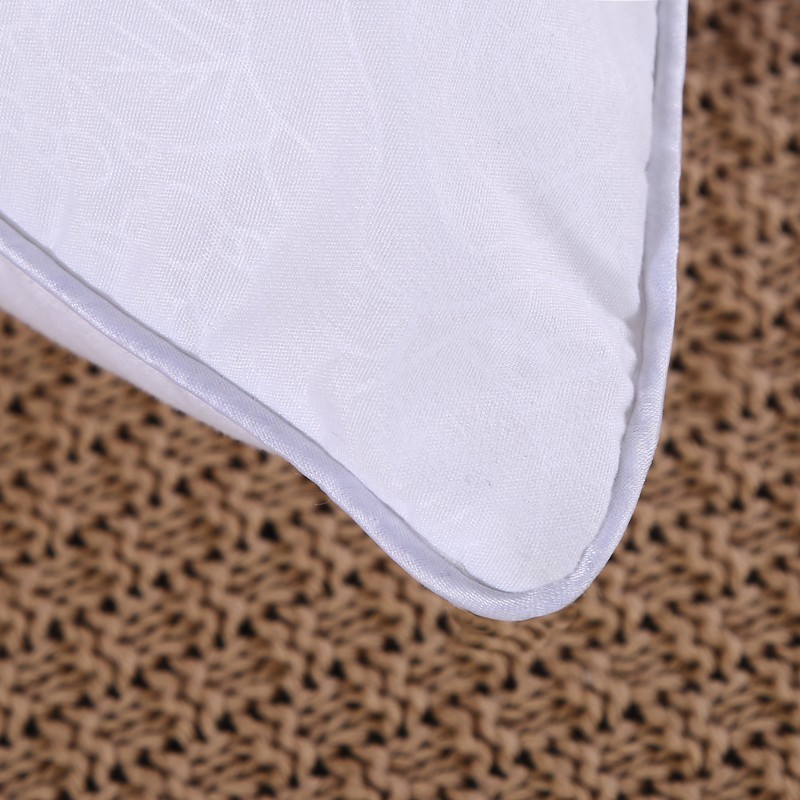
Additionally, commercial shells feature double-stitched edges. Sometimes, they include piped borders. This reinforcement stops fill leakage during rigorous industrial washing cycles.
Understanding the difference between fill power and fill weight will transform your buying process. Fill weight simply measures the physical weight of the stuffing in ounces. Heavy fill weight often causes a pillow to flatten into a hard pancake.
Fill power measures the fluffiness and volume of the down. Hotels prioritize high fill power, usually 600 or above. High fill power means the clusters trap more air. They provide incredible loft while remaining lightweight. They also spring back to life easily when housekeepers fluff them each morning.
The filling dictates how a pillow behaves over time. The hospitality sector essentially limits standard room inventory to two distinct categories. Let us break down the traditional luxury standard and the modern synthetic alternative.
For decades, pure goose and duck down represented the pinnacle of luxury. High-end boutique properties still heavily favor this natural material.
Pros: Down provides superior temperature regulation. It offers unmatched longevity and incredibly lightweight loft. It breathes naturally, keeping sleepers cool all night.
Cons: Natural down carries a higher price point. It requires daily fluffing to maintain its shape. It also raises potential allergen concerns, though high-heat commercial washing minimizes this issue significantly.
Buyer Consideration: Always look for the Responsible Down Standard (RDS) certification. This ensures ethical sourcing. Also, check the down-to-feather ratio. A 70/30 down-to-feather ratio provides an excellent balance of plushness and internal structure.
Many global hotel chains now standardize their bedding using advanced synthetic materials. These are not the cheap poly-fills you find in discount stores.
Pros: Down alternative materials are inherently hypoallergenic. They offer highly consistent support. They are far easier to maintain at home and provide a cost-effective luxury experience.
Cons: Synthetic materials naturally have a shorter lifespan than real down. They also retain slightly more body heat during the night.
Buyer Consideration: You must differentiate between cheap polyester batting and commercial-grade gel-fiber. Cheap batting clumps together into hard lumps after one wash. Commercial-grade blown gel-fiber accurately mimics the behavior of individual down clusters. It remains loose, airy, and easily moldable.
Feature | Natural Down | Gel-Infused Down Alternative |
|---|---|---|
Feel & Loft | Ultra-plush, highly moldable, sinks gently | Supportive, bounces back quickly, holds shape |
Breathability | Exceptional airflow, stays very cool | Good airflow, retains slightly more heat |
Allergen Profile | May trigger sensitive sleepers | 100% hypoallergenic |
Maintenance | Requires daily fluffing | Requires minimal fluffing |
You rarely see just one pillow on a luxury hotel bed. Housekeeping staff arrange a specific assortment of densities to cater to unpredictable guests.
Hotel managers cannot know your sleep position before you check in. Therefore, the standard operating procedure involves stocking beds with varying densities. A typical king-size bed features four pillows. Two of these are generally firm, and two are distinctly soft.
This dual-density strategy ensures every guest finds their ideal alignment. If you want to replicate the genuine resort experience at home, you should adopt this exact approach. Buying an identical pair of firm pillows limits your options if your sleep preferences shift.
Finding your perfect match depends entirely on your primary sleep posture. Here is how to navigate commercial densities:
Stomach Sleepers: You require the "Soft" or "Plush" options. Stomach sleeping forces your neck upward. A flat, soft profile prevents severe neck craning and spinal misalignment.
Back Sleepers: You require "Medium" density. This is often the standard down alternative option used by major chains. It supports the natural curve of your cervical spine without tilting your chin forward.
Side Sleepers: You require "Firm" density. Alternatively, look for gusseted designs. A gusset features a sewn-in fabric side panel. It creates a higher, boxier profile. This extra height completely fills the gap between your shoulder and ear.
The biggest difference between consumer bedding and commercial bedding lies in sheer endurance. Hotels view bedding as a heavy-use operational asset. They demand extraordinary resilience.
True commercial products from B2B suppliers face brutal conditions. Brands like Downlite or Standard Textile engineer their products specifically for industrial laundries. Industrial washing involves harsh detergents, massive loads, and extreme high-heat drying.
Retail pillows often fall apart after five trips through a home washer. The seams burst, or the fill migrates to one side. Commercial items survive hundreds of intensive wash cycles. The double-needle stitching and dense barrier weaves completely stop fill migration. The core maintains its structural integrity even after severe agitation.
Even commercial engineering has limits. Authentic B2B suppliers provide transparent replacement timelines for their corporate clients. Knowing these timelines helps set realistic expectations for home use.
A high-quality commercial down design typically lasts three to five years before the clusters break down. Down alternative versions generally last one and a half to three years. After this period, synthetic fibers gradually lose their structural integrity and bounce.
Retailers frequently use the term "hotel style" as a catchy marketing buzzword. They slap this label on standard, mass-produced merchandise. You must look past the packaging.
Always verify the commercial specifications before buying. Check for double-needle stitching along the perimeter. Look for cambric cotton barrier weaves. Confirm whether it actually uses a true chamber construction. If a brand cannot clearly list these structural features, it is just a standard retail pillow masquerading as a premium product.
Procuring authentic commercial bedding requires a strategic approach. You have two main purchasing avenues. Each path presents specific advantages and drawbacks.
Many famous hospitality chains now operate their own online boutiques. You can visit these websites and order exactly what you slept on.
The primary advantage is absolute certainty. You get a guaranteed exact match to your vacation experience. However, this convenience carries a hefty premium markup. You are paying extra for the luxury brand name stitched onto the tag.
A smarter, more cost-effective method involves identifying the original manufacturer. Hotels do not sew their own bedding. They contract large B2B manufacturers.
Many of these B2B manufacturers have recently opened direct-to-consumer retail branches. Purchasing directly from the supplier allows you to buy the exact same SKU. You bypass the luxury hotel brand markup entirely. You receive identical commercial-grade quality at a much more reasonable price point.
Use the following logic to finalize your purchase decision based on your specific needs:
Your Profile & Priorities | Recommended Purchase Action |
|---|---|
Budget constraints + Allergy prone | Opt for a commercial-grade gel-fiber down alternative. It is cost-effective and strictly hypoallergenic. |
Maximum longevity + True luxury feel | Opt for an RDS-certified chamber down design. It offers the longest lifespan and best temperature regulation. |
Unsure of exact sleep position preferences | Buy a bundle. Get one firm density and one soft density. This perfectly replicates the true hotel strategy. |
The magical luxury sleep experience you remember is not a mystery. It results from a highly replicable combination of commercial engineering and smart room setup. True Hotel Pillows utilize specialized chamber construction, extremely durable materials, and clever density pairing to achieve universal comfort.
As you shop for your home upgrade, prioritize structural design over flashy marketing terms. Look for double-stitched edges, breathable cambric cotton shells, and high fill power. Ignore extreme thread counts and cheap polyester batting. By following these commercial standards, you can finally bring the resort sleep experience directly into your own bedroom.
Actionable next steps include assessing your primary sleep position to determine your ideal density. Then, decide if you prefer the hypoallergenic benefits of modern gel-fiber or the classic loft of natural down. Finally, seek out authentic B2B suppliers to ensure you purchase a product built for authentic longevity.
A: Rarely as standard issue. Memory foam sleeps quite hot and offers a very subjective, rigid feel. Hotels need universal appeal. However, many luxury properties keep a stock of memory foam options available upon request via their dedicated "pillow menus."
A: Typically every 12 to 24 months. The exact timeline depends on the specific material and the hotel's star rating. Routine replacement ensures guests always experience consistent loft and proper neck support without hygiene concerns.
A: This sinking sensation comes from the high air-to-fill ratio of pure, high-fill-power down. The clusters compress softly to cradle your head. This is exactly why hotels pair a soft, sinking layer with a firmer supportive one underneath it.
A: Yes. Use a mild, enzyme-free detergent and run a gentle cycle. Dry them thoroughly on low heat. Toss two or three clean wool dryer balls into the machine. They will bounce around, break up wet clumps, and restore the original loft completely.


