
Views: 0 Author: Site Editor Publish Time: 2026-06-13 Origin: Site


We have all experienced the deep, restorative sleep of a luxury hotel stay. You wake up perfectly rested, only to return home to the frustration of flat, unsupportive retail cushions. This elusive "hotel sleep" is not magic, nor does it happen by accident. It is the direct result of strict commercial procurement standards, specific material ratios, and strategic layering designed to satisfy a wide variance of sleep styles every single night.
Replicating this experience at home requires a shift in how you evaluate bedding. You must ignore generic "hotel style" marketing buzzwords and focus entirely on commercial-grade specifications. In this guide, we will break down the exact construction of professional hospitality bedding. You will learn how to identify proper chamber designs, evaluate authentic fill power, and apply the exact stacking strategies professionals use to transform your nightly rest.
Authentic hotel pillows prioritize commercial durability (frequent hot-water laundering) and rely on specific inner-core constructions (chamber designs).
Hotels rarely use a single "perfect" pillow; they use a "Pillow Menu" strategy, stacking distinct densities (soft + firm) to accommodate all sleepers.
Replicating the feel requires evaluating fill power, feather-to-down ratios, and cambric cotton shells, rather than high thread counts.
Beware of retail brands slapping "Hotel Collection" on labels; genuine B2B hospitality suppliers offer transparent specs on fill weight and sourcing.
The hospitality industry faces a unique business problem. Properties must buy inventory that universally accommodates side, back, and stomach sleepers simultaneously. Furthermore, these products must survive rigorous daily washing and high-heat drying cycles without losing their structural loft. Standard retail options simply collapse under this operational stress. To solve this, the industry relies on specialized construction and commercial-grade fabrics.
Most premium hospitality properties utilize an industry-standard dual-chamber design. This engineering approach separates the structural support from the sensory comfort, offering the best of both worlds. It essentially places a pillow inside another pillow.
The inner core delivers the primary structural neck support. Manufacturers typically fill this central chamber with crushed feathers or highly dense synthetic fibers. Feathers possess a natural curvature or "spring" that resists compression, keeping the sleeper's cervical spine aligned even after hours of heavy pressure.
The outer layer provides the plush, immediate sensory experience. This outer envelope wraps around the firm core and is stuffed with pure down or micro-gel fiber. When your head hits the bed, you experience a luxurious, sinking softness. Moments later, the dense inner core catches your neck, preventing you from bottoming out against the mattress.
Consumer marketing heavily pushes ultra-high thread counts, convincing buyers that higher numbers equal higher quality. The hospitality sector entirely rejects this myth. Ultra-high thread count fabrics (like 800 or 1000 TC) require extremely thin, fragile yarns tightly packed together. They trap body heat, block airflow, and degrade rapidly under commercial laundering.
Instead, genuine Hotel Pillows rely on 230 to 300 thread count cambric cotton. This specific material offers distinct commercial advantages:
Down-Proof Weaving: The tightly woven cambric technique prevents sharp feather quills from poking through the fabric and scratching the guest.
Maximum Breathability: The 230-300 TC range allows air to easily pass through the shell, flushing out trapped body heat and keeping the sleeper cool.
Audible Crispness: Cambric cotton provides a distinct, satisfying crisp sound when compressed, heavily associated with luxury bedding.
Chemical Finishing: Commercial shells often feature calendering—a process where rollers apply heat and pressure to seal the fabric's pores naturally without harsh chemical sprays.
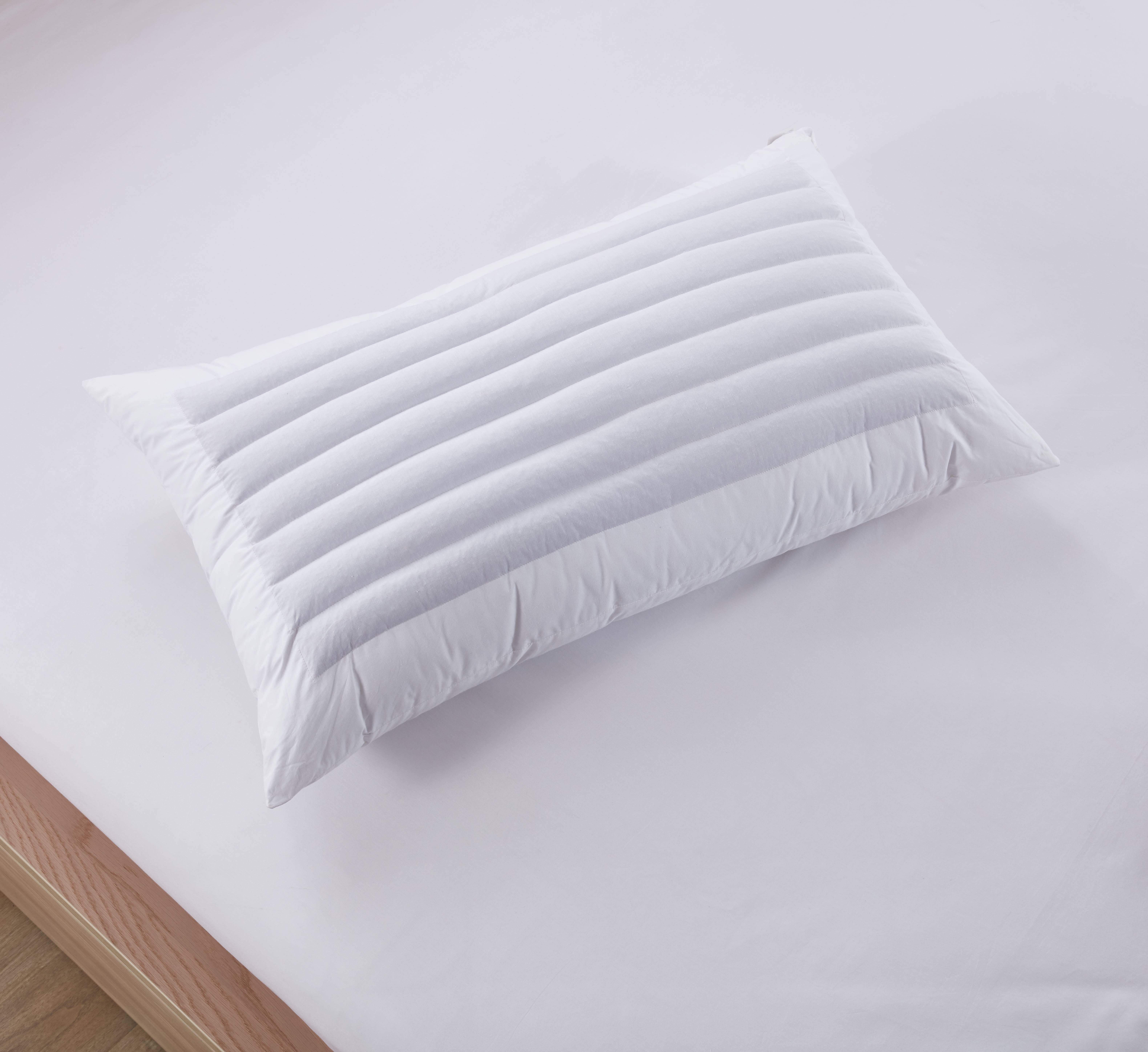
Understanding what goes inside the shell is critical. Commercial buyers evaluate fillings based on specific features and long-term performance outcomes. The debate generally comes down to traditional natural fills versus advanced synthetic alternatives.
Down and feather blends remain the gold standard for luxury hospitality. They offer unmatched longevity, superior malleability, and excellent temperature regulation. However, commercial buyers do not just order "down." They specify exact ratios based on the target density.
For a firm support base, buyers often specify a 75% feather and 25% down ratio. The high feather content delivers stiff, resilient support necessary for side sleepers. Conversely, a plush top layer often utilizes a 50/50 blend or an 80% down ratio. Down clusters lack stiff quills. They trap air brilliantly, providing that cloud-like fluffiness guests expect. Pure down is exceptionally expensive, which is why the dual-chamber design blending both materials remains the most popular commercial compromise.
Not every guest can sleep on natural feathers. Allergies dictate that properties must stock high-quality synthetic options. Down alternatives have evolved significantly past the clumpy, cheap polyester fill of the past. Today, commercial buyers source micro-gel fibers and advanced cluster-fiber technology.
These high-tech synthetics mimic the exact response time of natural down. The fibers are spun incredibly thin and coated in a slick microscopic finish, allowing them to glide past one another. This prevents the clumping and matting typically seen in retail polyester after a hot wash.
You must understand the trade-offs when choosing between natural and synthetic fills. Down alternatives offer an allergy-friendly, cost-effective solution, but they come with notable transparent assumptions. High-tech synthetics tend to sleep slightly warmer than natural down because plastic-based fibers do not breathe as efficiently as natural plumage.
Additionally, they possess a shorter lifespan. A high-quality down alternative will perform beautifully for about two to three years before the fibers begin to permanently compress. In contrast, premium natural down can easily last five to ten years with proper maintenance, making it a better long-term investment for your primary sleep setup.
Purchasing the correct materials is only half the battle. Replicating the five-star experience requires adopting the hospitality industry's implementation strategies. The biggest secret is surprisingly simple: one single unit rarely solves an ergonomic sleep problem.
Properties stack their beds with a minimum of four cushions, usually deploying a mix of varying densities. This "Pillow Menu" approach ensures that every guest, regardless of their anatomical needs, finds the exact right level of support. You should adopt this same stacking framework at home.
The framework consists of two distinct functional zones:
The Base Layer: This requires a firm or medium density. It acts as the structural foundation. Side sleepers will pull this layer under their neck for proper spinal alignment. It also serves as rigid back support when sitting up to read or watch television.
The Top Layer: This requires a soft or plush density. It sits closer to the sleeper. Back and stomach sleepers prefer this layer because it prevents their neck from bending upward at a harsh angle. Side sleepers often use it purely for comfort hugging or placing between their knees to align their hips.
Proper arrangement heavily impacts functionality. Hotels mechanically fluff their beds daily to trap air inside the chambers. To recreate this at home, grab the opposite diagonal corners and sharply push them together, then pull them apart. Repeat this on the other two corners. This creates a vacuum effect, sucking ambient air into the down clusters and restoring massive volume.
When making the bed, stand your firm base layer vertically against the headboard. Place the plush top layer slightly angled in front of it. This visually recreates the inviting, voluminous hotel aesthetic while keeping the structural tools separated and ready for use when you actually lay down.
Navigating the retail bedding market requires skepticism. Many consumer brands use deceptive marketing to simulate luxury without providing commercial-grade materials. You need a rigorous evaluation process to separate genuine hospitality suppliers from clever retail marketers.
First, ignore the naming conventions entirely. Disregard labels that scream "Hotel Quality" or "Luxury Hotel Collection." These are legally meaningless marketing terms. Instead, look for brands that actually operate B2B supply chains for hospitality chains. Companies like Downlite, Standard Textile, and Pacific Coast Feather Company are actual suppliers that also sell direct-to-consumer.
Next, check the fill power and fill weight. Fill power measures the volume that one ounce of down occupies. It dictates the quality and fluffiness. A benchmark of 600+ fill power indicates high-quality, mature down that will retain its loft for years. Fill weight, measured in ounces, dictates the firmness. More ounces stuffed into the shell equals a firmer, denser profile.
Finally, verify independent certifications. Do not trust marketing claims about cleanliness. Look for the RDS (Responsible Down Standard) certification, which guarantees the ethical sourcing and traceability of the feathers. You should also demand the OEKO-TEX Standard 100 label. This certification ensures the fabric and fills are completely free of harmful chemicals, heavy metals, and toxic dyes.
Use the following matrix to match your primary sleep position to the recommended commercial fill density and inner core ratio.
Sleep Position | Recommended Density | Ideal Fill Composition | Primary Ergonomic Goal |
|---|---|---|---|
Side Sleeper | Firm / Extra Firm | Chamber Design (75% Feather Core) | Fill the large gap between the shoulder and the ear; keep spine neutral. |
Back Sleeper | Medium | 50/50 Down and Feather Blend | Support the natural curve of the cervical spine without tilting the chin forward. |
Stomach Sleeper | Soft / Plush | Pure Down or Micro-gel (Low fill weight) | Provide a nearly flat profile to prevent lower back hyperextension. |
Even when armed with the right knowledge, consumers frequently encounter implementation and maintenance risks. Buying an excellent product does not guarantee immediate sleep success if you fail to account for your unique bedroom environment.
A common mistake is buying the exact model a hotel uses, only to find it feels completely different at home. This usually happens because your mattress firmness differs drastically from the hotel's bed. If you have a plush, sinking memory foam mattress, your body drops deeper into the bed, requiring a thinner, softer head support. If you use a rock-hard firm mattress at home, your body rests high on top of it, requiring a much thicker, firmer cushion to bridge the gap to your neck. Always adjust your density choice based on how deeply your torso sinks into your current mattress.
Retail knock-offs pose a massive risk. Department stores frequently sell cheap poly-fill cushions branded as "luxury hotel." These cheap synthetics feel great in the store, but the loose, non-siliconized fibers quickly bind together. They flatten out into lumpy, dense pancakes within just a few months of use.
You can easily spot a knock-off by checking the seams. Commercial-grade hospitality items require double-needle stitching and piped edges to survive aggressive laundering. Cheap retail versions usually feature a flimsy, single-stitched seam that will easily burst under pressure.
Authentic Hotel Pillows demand active maintenance. They will inevitably go flat if you treat them passively. You must set realistic expectations for daily and quarterly care.
Best Practices | Common Mistakes |
|---|---|
Mechanically fluffing by aggressively pushing opposite corners together every morning. | Leaving them flat on the bed, allowing body moisture to weigh down the down clusters. |
Washing quarterly on a warm, gentle cycle with mild liquid detergent. | Using heavy powder detergents or fabric softeners that coat and ruin the natural down fibers. |
Drying on low heat for multiple cycles with three clean tennis balls to physically punch the clusters apart. | Air-drying, which leaves the inner core damp, leading to foul odors and permanent mildew damage. |
Upgrading to authentic hospitality bedding represents a serious investment in your daily sleep ergonomics, not just a frivolous luxury purchase. The comfort you experience on vacation comes from rigorous engineering, specific down-to-feather ratios, and durable, breathable cambric cotton shells. By adopting commercial standards, you ensure your cervical spine remains aligned and comfortable night after night.
Your immediate next steps should be action-oriented. First, audit your current setup using the "fold test": fold your cushion in half, and if it fails to spring back open immediately, it is dead and offering zero structural support. Second, identify your preferred density based on the hotel layering strategy and your specific mattress type. Finally, bypass generic retail stores entirely and source your replacements directly from transparent, commercial-grade B2B bedding suppliers.
A: Yes. Many major luxury chains operate their own online boutiques where they sell the exact bedding used in their rooms. Alternatively, you can check the physical tag during your stay to identify the B2B supplier (such as Downlite or Standard Textile) and purchase directly from their consumer-facing websites.
A: Commercial properties typically operate on an 18 to 36-month replacement lifecycle. The rigorous daily washing degrades the materials faster than home use. In a standard residential setting with proper care and protective covers, a high-quality down model can last three to five years before needing replacement.
A: They go flat due to a lack of daily professional maintenance. Hotel housekeepers aggressively fluff the bedding every single morning, forcing ambient air back into the down clusters. Furthermore, improper home washing—specifically air-drying instead of machine-drying with tennis balls—causes the inner fills to clump and lose their loft.


